
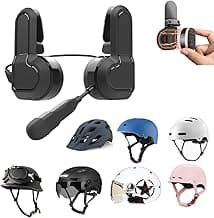
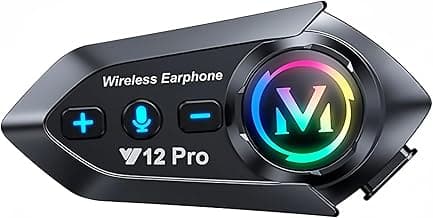
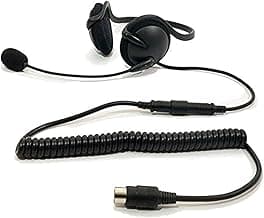
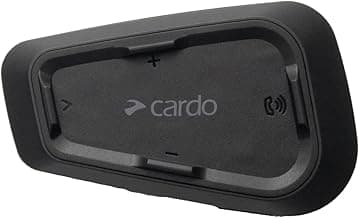
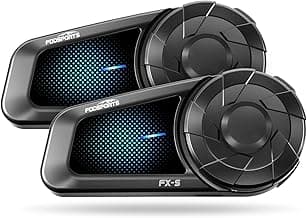
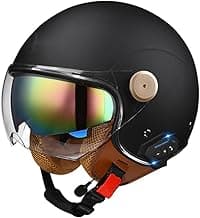
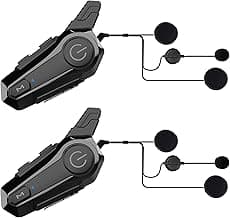
Market Overview and Core Technological Evolution
The landscape of motorcycle connectivity has shifted from simple point-to-point Bluetooth pairings to complex, self-healing Mesh networks. For a long time, riders were tethered by the limitations of "daisy-chain" connections, where one rider leaving the group would collapse the entire communication bridge. Modern evolution has introduced dynamic mesh protocols that allow for near-instantaneous reconnection and support for dozens of simultaneous users. This technological leap is particularly relevant for those seeking best gift ideas for him, as it represents a tangible upgrade in both safety and social utility.
Providing a rider with a communication system is an investment in their safety, allowing for critical hazard warnings and navigation cues without the distraction of physical devices.
Manufacturers often claim "kilometer-long" ranges, but technical skepticism is required here. In a half helmet configuration, signal attenuation is a significant factor. The lack of a protective shell around the microphone means the system must work exponentially harder to filter out white noise. Current motor technology in these devices has pivoted toward high-density lithium-polymer cells and Bluetooth 5.0+ standards, which offer lower power consumption and higher data throughput, essential for maintaining high-fidelity audio in harsh environments.
Technical Benchmarks: Evaluating Core Performance Physics
To identify a truly superior system, an engineer must evaluate three primary metrics: Signal-to-Noise Ratio (SNR), ingress protection (IP) ratings, and speaker impedance. In an open-ear environment, the Digital Signal Processing (DSP) must be capable of identifying the specific frequency of human speech and isolating it from the chaotic frequencies of wind shear and engine vibration. This is a far more rigorous requirement than what is found in best active noise cancelling headphones designed for static environments.
| Feature | Standard Bluetooth Intercom | Advanced Mesh Technology |
|---|---|---|
| Connection Type | Linear (Daisy-Chain) | Web/Grid (Self-Healing) |
| Latent Reconnection | Manual / Slow | Automatic / Instantaneous |
| Audio Clarity | Compressed, mono-heavy | High-definition, multi-channel |
| User Capacity | Limited (Usually 2-4) | Expansive (Up to 24+) |
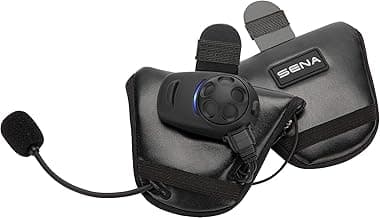
Furthermore, the physical speakers must be analyzed. Most half helmet communication kits use 40mm drivers. However, the driver's thickness and the magnetic flux of the neodymium magnets determine whether the audio will "distort" at the high volumes necessary to overcome wind at highway speeds. A "clinical" filtration system for the microphone—often involving dual-mic arrays—is the only way to ensure the recipient of a call hears a clear voice rather than a muffled roar. When considering What do men want for Valentine's Day?, a device that solves these specific physics challenges offers much more value than a generic gadget.
Ergonomics, Accessibility, and Biomechanical Considerations
For a half helmet user, ergonomics are not just about comfort; they are a safety requirement. The device must be operable with thick, leather-armored gloves. This necessitates tactile, high-relief buttons or a "jog-dial" system that provides mechanical feedback. Biomechanically, the mounting of the device should not significantly alter the helmet's center of gravity. A heavy unit mounted far to one side can cause neck fatigue during long-duration rides.
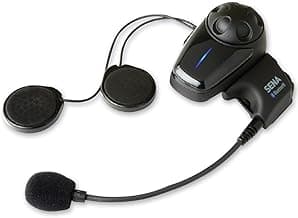
The "boom microphone" is a critical component for half helmets. From an engineering perspective, the arm must be stiff enough to resist "wind-walk" (moving out of position at speed) yet flexible enough to be positioned precisely in the rider's "quiet zone" near the lips. For older riders or those with limited dexterity, voice-command integration is a mandatory feature, allowing them to control music or intercom functions without taking their hands off the grips. This level of utility makes such devices a top contender when looking for the best watch to buy for men style of longevity and daily use.
The Economics of Ownership: Short-Term Budget vs. Long-Term Viability
The market is flooded with low-cost "no-name" units that promise similar features to premium systems. However, the economics of long-term ownership favor the modular, well-engineered units. Cheap devices often utilize lower-grade plastics that degrade under UV exposure and non-replaceable batteries that lose 30% of their capacity after just one season of thermal cycling. In contrast, a high-quality system is designed with repairability in mind, offering replaceable mounting clips, speaker pads, and firmware updates that keep the device compatible with evolving smartphone OS versions.
True value in motorcycle electronics is found in the intersection of modular hardware and persistent software support, ensuring the device remains functional for years rather than months.
Warranty nuances are equally vital. A "Buy It For Life" (BIFL) approach involves checking for independent parts availability. If a rider damages the boom mic on a budget unit, they often have to replace the entire system. A premium system allows for the replacement of that specific component for a fraction of the cost. This durability is why a high-end best bluetooth motorcycle helmet accessory is considered a superior gift compared to disposable tech. If you are searching for a best gift for my husband, choosing a brand with a proven track record of hardware support is the most financially sound decision.
Methodological Evaluation Criteria: How Experts Test
Rigorous testing of Bluetooth communication for half helmets involves more than just a quick "parking lot test." A valid methodology includes the following stages:
- Acoustic Stress Testing: Measuring speech intelligibility (using the STI scale) at 40, 60, and 80 miles per hour to determine the effectiveness of the noise-suppression algorithms.
- Battery Degradation Analysis: Subjecting the unit to extreme thermal ranges (-10°C to +40°C) to simulate real-world riding conditions and measuring the discharge rate.
- Ingress Resilience: Testing the IP67 rating by subjecting the unit to high-pressure water jets and dust chambers to ensure the internal circuitry remains sealed.
- Intercom Stability: Testing the "re-entry" time for a Mesh node in a high-interference urban environment (e.g., downtown areas with high radio frequency traffic).
By simulating the philosophy of a high-end laboratory, we can conclude that the best systems are those that prioritize signal integrity and physical resilience over "gimmick" features like built-in FM radios or flashing LED lights.
Frequently Asked Questions (Technical & Practical)
Q: Can a Bluetooth system be fitted to any style of half helmet?
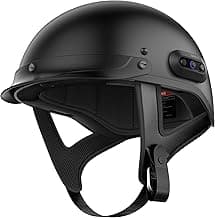
Most universal communication systems utilize a clamp or adhesive mount that is compatible with the vast majority of half helmet shells, provided there is a small gap between the shell and the EPS liner. However, riders should ensure the helmet has "ear pockets" or a neck curtain to house the speakers, as mounting speakers directly against the ear without a recess can cause significant discomfort and pressure points over time.
Q: How does wind noise affect the voice-activation (VOX) features?
Wind noise can falsely trigger the VOX sensor if the sensitivity is not properly calibrated or if the digital signal processing is inadequate. Higher-end systems allow for manual adjustment of VOX sensitivity via a smartphone app, ensuring the intercom only opens when the rider purposefully speaks, thereby preserving battery life and reducing constant "static" in the ears of other group members.
Q: Is there a significant difference between Bluetooth 4.1 and Bluetooth 5.2 in helmets?
Bluetooth 5.2 provides significantly better power management, faster pairing, and increased data range compared to the 4.1 standard. In the context of a motorcycle gift, a 5.0+ system ensures better compatibility with the latest smartphones and reduces the "audio lag" or latency that can occur when using GPS navigation and music streaming simultaneously.
Q: Why do some systems sound "tinny" compared to high-end headphones?
The "tinny" sound is usually a result of small driver size (often limited by helmet space) and the lack of an acoustic seal around the ear. In a half helmet, the speakers are fighting an "infinite baffle" environment, meaning the bass frequencies escape easily. Some premium units offer "HD Speakers" with improved frequency response curves specifically tuned to cut through wind noise without sounding shrill.
Q: How long should a battery realistically last on a long-distance tour?
A well-engineered system should provide between 10 to 13 hours of continuous "talk time" on a single charge. It is critical to look for units that support "fast charging" or allow the device to be used while plugged into a 12V DC power source or a portable battery pack, which is a life-saver for riders on multi-day excursions without regular access to AC outlets.