

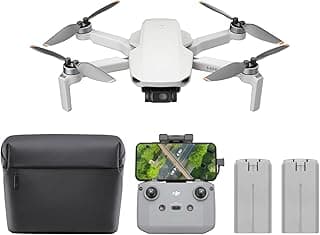
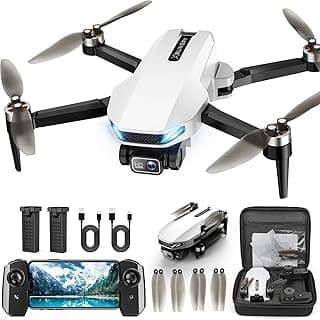
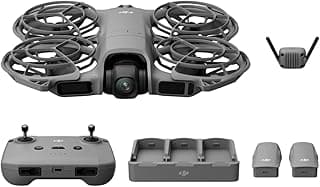
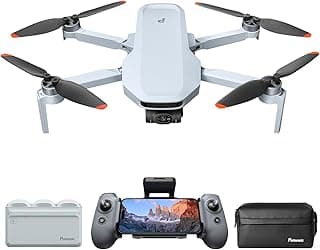
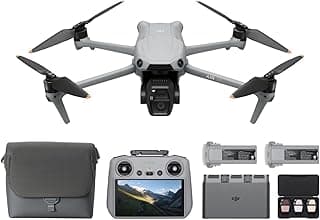
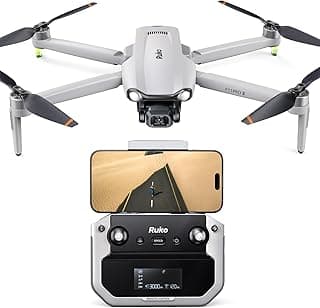
Choosing the best drone for professional photography as a gift requires a departure from standard consumer electronics logic. While a smartphone or a laptop relies on processing power, a high-altitude imaging system is a complex synergy of aerodynamics, optics, and signal processing. For the gift-giver, the challenge is identifying a machine that provides more than just a novelty flight experience; it must serve as a reliable tool for creative expression. When we look at best gift ideas for him or any creative professional, a drone represents the ultimate fusion of hardware engineering and artistic potential.
From a mechanical engineering perspective, the stability of an aerial platform is dictated by the angular vibration range of its gimbal. A professional-grade system typically features a 3-axis mechanical gimbal with a precision of ±0.01°. Without this level of stabilization, even the highest-resolution sensor will produce "rolling shutter" artifacts or motion blur, rendering the footage useless for high-end production. This technical nuance is often overlooked in marketing materials that focus solely on "4K" labels, which offer no guarantee of actual image clarity in turbulent wind conditions.
Gifting tech is about more than specifications; it is about upgrading the recipient's window to the digital world, ensuring every frame is a testament to quality.
The core of any best drone for professional photography is the sensor architecture. For a gift to truly stand the test of time, one should prioritize a sensor size of at least 1 inch. Smaller sensors, common in budget models, suffer from significant "noise" in low-light environments and lack the dynamic range required to capture the subtle gradients of a sunset. A larger CMOS sensor allows for larger individual pixels, which increases the signal-to-noise ratio. This is essential for professionals who need to "color grade" their footage in post-production. If you are wondering What is someone that loves technology?, they are often individuals who appreciate these technical granularities over superficial features.
To help you navigate the vast array of best quality drones, it is useful to compare the mechanical and optical variables that define professional performance. The following table breaks down the critical hardware segments that a gift-giver should evaluate before making a high-ticket investment.
| Technical Variable | Consumer Tier | Professional/Cine Tier | Real-World Impact |
|---|---|---|---|
| Sensor Physical Size | 1/2.3-inch or 1/1.3-inch | 1-inch or Micro Four Thirds | Better dynamic range and low-light performance. |
| Video Codec Support | H.264 / H.265 | Apple ProRes 422 HQ | Enables professional color correction without degradation. |
| Transmission Range | 4km - 6km (Standard) | 12km - 15km (OcuSync/Enhanced) | Higher signal redundancy and lower latency in urban areas. |
| Obstacle Sensing | Forward/Backward only | Omnidirectional (360 degrees) | Significantly reduces risk of catastrophic hardware failure. |
A major consideration for any best professional drone is the "Buy It For Life" (BIFL) potential. Drones are notoriously difficult to repair due to their proprietary, tightly packed internal components. When selecting a gift, look for brands that offer modularity—specifically, models where the propellers, landing gear, and even the gimbal can be replaced without specialized soldering. Furthermore, consider the hidden costs of ownership. High-performance Lithium-Polymer (LiPo) batteries have a finite lifecycle, typically degrading after 200 to 300 charge cycles. A thoughtful gift should include a "Fly More" combo that provides extra batteries, as a single 20-minute flight window is rarely sufficient for professional location scouting.
When searching for best gifts for xmas or major milestones, the unboxing experience of a high-end drone is unparalleled. However, the recipient's living environment must be considered. In high-density urban areas, the best drone for professional photography must have robust anti-interference technology. Dual-band or tri-band transmission systems (2.4GHz, 5.8GHz, and sometimes 5.1GHz) are essential to prevent "signal dropouts" caused by the saturation of Wi-Fi signals in city centers. For those who prefer a more visceral, manual flight experience, exploring a best rtf fpv drone might be an alternative, though these require a significantly higher skill floor compared to standard photography drones.
The psychological aspect of gifting such an instrument is significant. You are essentially providing a "new perspective" to the recipient. To ensure the gift is successful, one must think about how to come up with good gift ideas that align with the recipient's existing workflow. Does the person already use professional editing software? If so, they will appreciate a drone that shoots in D-Log or 10-bit DLOG-M profiles, which preserve a flat color profile for maximum flexibility. If they are a beginner, look for "QuickShot" modes that use AI to perform complex cinematic maneuvers like "Dronies" or "Orbits" automatically.
Safety is the final technical pillar. Modern best aerial photography drone systems utilize redundant IMUs (Inertial Measurement Units) and compasses. If one sensor fails due to magnetic interference, the secondary sensor takes over to prevent a "flyaway." For a gift that is meant to be what makes a memorable gift, the peace of mind provided by these safety features is invaluable. It ensures that the thousands of dollars invested in the device are protected by intelligent software that can automatically navigate back to the takeoff point if the battery runs low or the signal is lost.
Frequently Asked Questions
Is it worth buying a drone with a Hasselblad camera?
Yes, because the color science and lens quality provided by specialized camera partnerships significantly reduce the time required for post-production editing. While the hardware cost is higher, the "Natural Color Solution" found in high-end sensors ensures that skin tones and landscapes look realistic without heavy manual adjustment.
Do professional drones require a license to fly?
Yes, in most countries, any drone used for commercial purposes—or even for hobbyist use if it exceeds a certain weight (typically 249g)—requires registration and sometimes a remote pilot certificate. Before gifting, check local regulations as the recipient will need to comply with these laws to avoid heavy fines.
How does wind resistance affect photography?
Wind resistance determines the "steadiness" of the frame and the safety of the flight. A drone with Level 5 wind resistance can remain stationary in winds up to 10.5 m/s. For professional photography, high wind resistance is critical to ensure long-exposure shots (like those used for blurred water effects) remain sharp despite the movement of the air.
Should I choose a drone with internal storage?
Yes, ideally. While most drones rely on microSD cards, having at least 8GB to 1TB of internal "onboard" storage acts as a vital fail-safe in case the user forgets their memory card or the card suffers a write-speed error during a high-resolution 5.1K recording session.
In conclusion, the best drone for professional photography is not just a flying camera; it is a sophisticated piece of aerospace engineering. By focusing on sensor size, transmission reliability, and repairability, you can provide a gift that empowers a creator to capture the world from an entirely new vantage point, ensuring the investment remains functional and relevant for years to come.